General reading / Note 03 / Materials
Order beneath the surface
A familiar material opens a question about how solids are arranged.
An educational note, separate from company information.
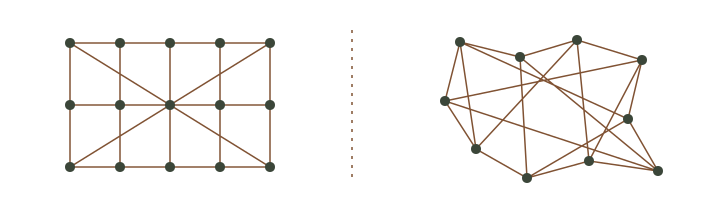
A solid without a repeating lattice
Many familiar solids have crystalline structures: their constituent atoms or other building units follow a repeating arrangement over long distances. Glass is amorphous. Its structure does not have that same long-range repeating order.
Amorphous does not mean completely without structure. Neighboring atoms still have relationships and constraints. The distinction concerns how far a regular pattern continues. A sketch of scattered dots can suggest irregularity, but it leaves out the three-dimensional connections and chemistry of a real material.
Arrangement is part of the story
A useful hypothetical comparison is a floor covered with identical tiles in a repeating pattern and a mosaic assembled without a repeating layout. Both are solid arrangements. Their visual order differs. This comparison introduces an idea about organization; it is not a model of atomic bonding or a prediction of strength.
Composition and processing also influence a material’s properties. The word glass alone does not tell you how a particular piece will respond to heat, impact or light. Nor does the word crystalline tell you everything about a ceramic. Structure is one part of a description that needs other information alongside it.
Glass ceramics combine a glass phase with crystalline regions. They provide a reminder that material categories can meet within one engineered material. A simple either-or drawing is a starting point for vocabulary, rather than a complete map of the subject.
Looking past the familiar surface
Transparency is an optical property, not the definition of glass. A material’s composition, internal features and the wavelengths being considered all affect how light travels through it. Appearance alone is therefore an incomplete guide to internal structure.
When reading about a new material, separate three questions: what is it made of, how is it arranged, and how was its behavior assessed? A claim about one does not settle the others. That small habit helps turn a familiar object into a more precise question, without assuming that a name or a photograph provides the whole explanation.
Further reading: Corning on glass and ceramics.