General reading / Note 01 / Microscopy
Bigger is not always clearer
An enlarged view is useful. A resolved detail tells you something more.
An educational note, separate from company information.
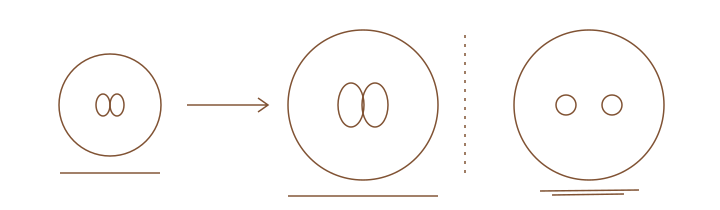
Two different questions
Magnification describes how large a specimen appears compared with its actual size. Resolution describes the ability to distinguish nearby features as separate. These ideas work together in microscopy, but increasing one does not automatically improve the other. A larger image can still contain the same unresolved information.
Think of a hypothetical printed page photographed from far away. Enlarging that photograph may make the shapes of the lines more visible, yet letters that merged into a blur remain difficult to separate. Making the display bigger has not recovered the missing detail. This analogy explains the distinction; it is not a test of a microscope.
Where detail comes from
In a conventional light microscope, the wavelength of illumination and the light-gathering ability of the objective help determine which fine features can be distinguished. The latter is described by numerical aperture. Lens corrections and appropriate imaging conditions also matter to the image that reaches the viewer.
A photograph of a microscope image introduces another layer: the camera and display. Zooming on the screen changes the presentation of the captured image. It does not by itself change the optical information originally collected. A clear explanation of an image therefore needs more than a magnification number.
Read the image with its context
A scale bar connects a displayed distance to a distance in the specimen. It is useful when an image is resized because the bar can be resized with it. A caption can add the imaging method and explain what the visible contrast represents.
When reading a scientific image, first ask what feature the author wants you to notice. Then ask whether two nearby features are actually distinguishable, and how the scale is shown. An attractive enlargement and a meaningful observation are different judgments. Keeping both questions open makes the image easier to interpret.
Further reading: ZEISS on objective lenses.